
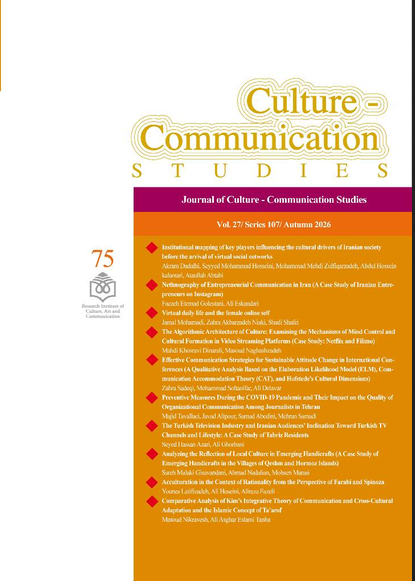
Culture-Communication Studies is published by Institute of Culture, Art and Communication (Ministry of Culture and Islamic Guidance).
The aim of this journal is to provide a forum for communication professionals to discuss about cultural issues. The statements and opinions expressed in this journal do not necessarily represent the views of the publisher.
In order to fulfill the duties emphasized in its statute, as well as to provide the ground for scholarly dialogue in the fields of culture and communication and to benefit from scientific theories in order to solve problems and cultural policy-making, the Research Institute for Culture, Art and Communication has published a quarterly journal entitled "Culture-Communication Studies". Fortunately, this publication, which has enjoyed considerable reception among thinkers and writers in various fields of social sciences, is a forum for reflecting opinions and thoughts on the issues affecting the Ministry of Culture and Islamic Guidance. In the new period, special efforts have been made to involve all academics from all over the country in this scientific dialogue, and the journal is not only dedicated to empirical research articles. With this approach, in order to make the quarterly as dynamic as possible, any kind of scientific participation, from theoretical and creative notes to critical review of books in this field, is welcomed. From our point of view, the quarterly magazine is a vehicle for interaction and dissemination of intellectuals and intellectuals on the one hand, and those in charge of cultural and artistic affairs on the other. The formats we design for the publication of articles should not hinder a live dialogue between thinkers. For this reason, we invite all those who have a reaction to the published articles and notes to reflect their note or article at the appropriate time (as soon as possible) so that it will be reflected in the quarterly out of turn.
This journal is following of Committee on Publication Ethics (COPE) and complies with the highest ethical standards in accordance with ethical laws. All submitted manuscripts are checked for similarity through Samim Noor software to ensure their authenticity.Scientific Quarterly of Culture-Communication Studies ranked "A", in 2023 evaluation of the scientific journals of the Iranian Ministry of Science, Research and Technology. According to ISC (Islamic World Science Citation Center), the media journal has achieved an impact factor of 0.633 and a Q1 ranking in the year 2021.
Download the conflict of interest file in Word format
Download the commitment of compliance file in Word format
Download the article structure format file in Word format


This work is licensed under a Creative Commons Attribution 4.0 International License.
Pages 9-44
10.22083/jccs.2026.555330.4127
Akram Dadalhi, Seyyed Mohammad Hosseini, Mohammad Mehdi Zulfiqarzadeh, Abdul Hossein kalantari, Ataullah Abtahi
Pages 45-72
10.22083/jccs.2026.534673.4069
faeze etemad golestani, علی اسکندری
Pages 73-118
10.22083/jccs.2025.543509.4093
jamal mohamadi, Zahra Akbarzadeh Niaki, Shadi Shafei
Pages 119-146
10.22083/jccs.2026.573626.4160
Mahdi Khosravi dinarali, Masoud Naghash zadeh
Pages 147-175
10.22083/jccs.2026.559017.4133
zahra sadeghi, mohammad soltanifar, ali delavar
Pages 177-202
10.22083/jccs.2026.564581.4147
majid tavallaei, javad alipor, samad abedini, mehran samadi
Pages 203-239
10.22083/jccs.2025.531838.4060
Seyed Hassan Azari, Ali Ghorbani
Pages 241-270
10.22083/jccs.2025.473331.4078
sareh malaki, Ahmad Nadalian, Mohsen Marasy
Pages 271-297
10.22083/jccs.2026.553520.4117
yones letifizade, ali hoseini, alireza fazeli
Pages 299-334
10.22083/jccs.2026.511367.4081
Masoud Nikravesh, Ali Asghar Eslami Tanha


